Year 6 Maths: The Complete Curriculum Guide for Parents
- Year 6 ends with KS2 SATs in May — three maths papers, all without a calculator
- Numbers to 10,000,000; BODMAS/BIDMAS order of operations tested explicitly
- Ratio and proportion appear for the first time — a common source of SATs marks
- Algebra introduced: missing number problems, formulae, linear sequences
- Fractions/decimals/percentages are the most heavily tested area across all three papers
- Paper 1 is arithmetic (30 min); Papers 2 & 3 are reasoning (40 min each)
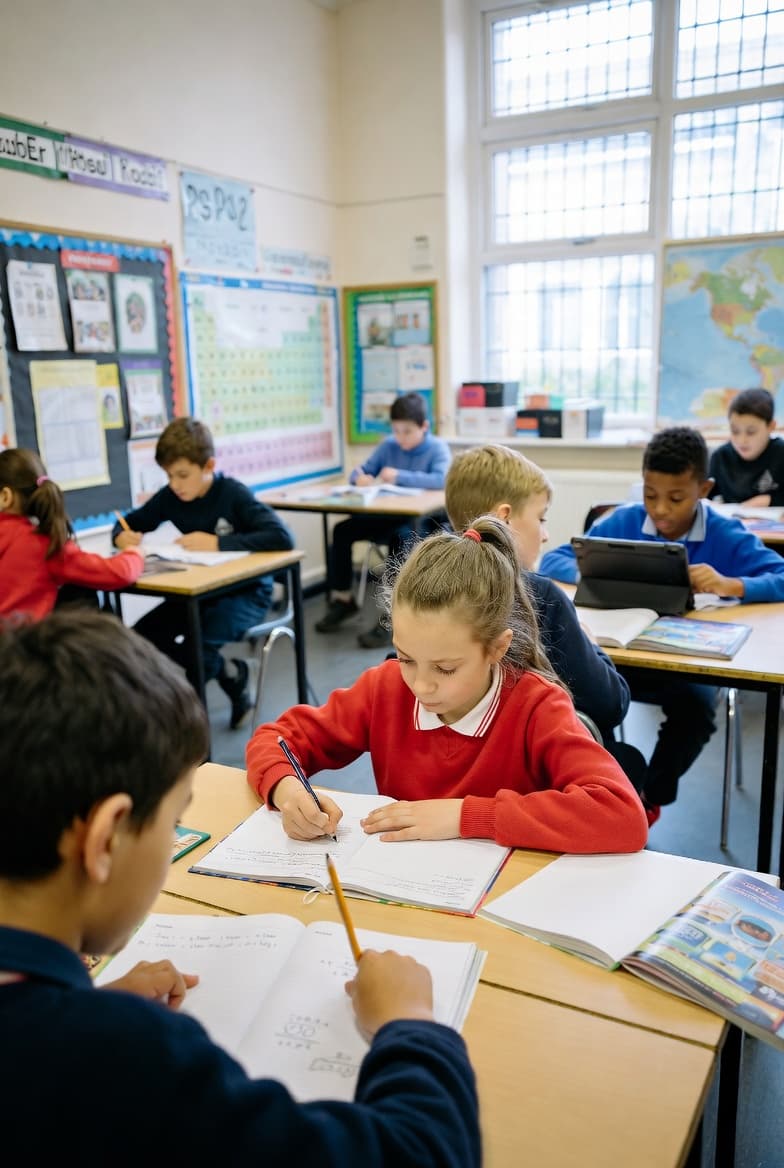
Overview: What Makes Year 6 Different
Year 6 is the final year of primary school, and for most children the most academically demanding. The maths curriculum reaches its peak complexity — introducing algebra and ratio while also expecting mastery of everything covered in Years 1 to 5. At the end of the year, children sit the KS2 SATs, which include three maths papers.
The national curriculum for Year 6 maths is published by the Department for Education (DfE) and covers six strands: number and place value, the four operations, fractions/decimals/percentages, ratio and proportion, algebra, and measurement/geometry/statistics. The content below follows the statutory programme of study, with practical guidance for parents.
Number and Place Value
In Year 6, place value extends to numbers up to 10,000,000. Children should be able to:
- Read, write, order, and compare numbers up to 10,000,000 and determine the value of each digit
- Round any whole number to a required degree of accuracy
- Use negative numbers in context (e.g. temperature) and calculate intervals across zero
Worked Example: Intervals Across Zero
The temperature at midnight is −4°C. By noon it has risen by 11 degrees. What is the temperature at noon?
−4 + 11 = 7°C. Count up 4 to reach 0, then 7 more to reach 7.
The Four Operations and BODMAS
Year 6 introduces the order of operations, commonly known as BODMAS (Brackets, Orders, Division, Multiplication, Addition, Subtraction) or BIDMAS. This is tested explicitly in the SATs arithmetic paper.
Children are expected to:
- Multiply multi-digit numbers up to 4 digits by a 2-digit number using long multiplication
- Divide numbers up to 4 digits by a 2-digit number using long division, interpreting remainders as whole numbers, fractions, or by rounding
- Perform mental calculations including with mixed operations and large numbers
- Use estimation to check answers
- Solve problems involving all four operations, including multi-step problems
Worked Example: BODMAS
Calculate: 3 + 4 × 5
Multiplication before addition: 4 × 5 = 20, then 3 + 20 = 23 (not 35).
A common SATs error is ignoring BODMAS and calculating left to right. Practise identifying which operation comes first before calculating.
Fractions, Decimals, and Percentages
This is the most heavily tested area across all three SATs papers. Year 6 pupils need to:
- Use common factors to simplify fractions; use common multiples to express fractions in the same denomination
- Add and subtract fractions with different denominators and mixed numbers
- Multiply pairs of proper fractions, writing the answer in its simplest form
- Divide proper fractions by whole numbers (e.g. ⅓ ÷ 2 = ⅙)
- Identify the value of each digit up to three decimal places
- Multiply and divide numbers by 10, 100, and 1,000 giving answers up to three decimal places
- Recall and use equivalences between simple fractions, decimals, and percentages
- Solve problems involving the calculation of percentages (e.g. 15% of 360)
Key Equivalences to Know by Heart
| Fraction | Decimal | Percentage |
|---|---|---|
| ½ | 0.5 | 50% |
| ¼ | 0.25 | 25% |
| ¾ | 0.75 | 75% |
| ⅕ | 0.2 | 20% |
| ⅒ | 0.1 | 10% |
| ⅓ | 0.333… | 33.3…% |
| ⅛ | 0.125 | 12.5% |
Worked Example: Percentage of an Amount
Find 15% of 360.
10% of 360 = 36. 5% = half of 10% = 18. So 15% = 36 + 18 = 54.
Ratio and Proportion
Ratio and proportion appear for the first time in Year 6 and are frequently tested in SATs reasoning papers. Children are expected to:
- Solve problems involving the relative sizes of two quantities using ratio notation (e.g. 3:1)
- Solve problems involving similar shapes where the scale factor is known
- Solve problems involving unequal sharing and grouping using knowledge of fractions and multiples
Worked Example: Sharing in a Ratio
Share 40 sweets between Ali and Beth in the ratio 3:5.
Total parts = 3 + 5 = 8. One part = 40 ÷ 8 = 5. Ali gets 3 × 5 = 15. Beth gets 5 × 5 = 25.
Ratio questions are among the highest-scoring areas in SATs — children who practise them regularly tend to pick up marks that others miss.
Algebra
Algebra is new in Year 6 and can be a source of anxiety for children and parents alike. However, at this level it is fairly accessible — it builds on “missing number” work children have been doing since Year 1:
- Use simple formulae (e.g. area = length × width)
- Generate and describe linear number sequences (e.g. the rule is “add 7”)
- Express missing number problems algebraically (e.g. n + 5 = 12, so n = 7)
- Find pairs of numbers that satisfy an equation with two unknowns (e.g. a + b = 10)
- Enumerate possibilities of combinations of two variables
Worked Example: Two Unknowns
a + b = 8 and a − b = 2. Find a and b.
If a + b = 8 and a − b = 2, then adding both equations: 2a = 10, so a = 5 and b = 3.
Framing algebra as “finding the missing number” — something children have been doing since Year 1 — often makes it feel far less intimidating. Using bar models or function machines can also help.
Geometry, Measurement, and Statistics
Geometry
- Draw, translate, and reflect shapes on a coordinate grid; describe shapes using coordinates in all four quadrants
- Recognise, describe, and build simple 3D shapes, including making nets
- Illustrate and name parts of circles: radius, diameter, circumference
- Know that angles in a triangle sum to 180° and angles in a quadrilateral sum to 360°
- Find unknown angles in any triangles, quadrilaterals, and regular polygons
- Recognise vertically opposite angles
Measurement
- Calculate the area of parallelograms and triangles
- Calculate, estimate, and compare the volume of cubes and cuboids using standard units (cm³ and m³)
- Convert between miles and kilometres (know that 5 miles ≈ 8 km)
Statistics
- Interpret and construct pie charts and line graphs
- Calculate and interpret the mean as an average
Worked Example: Mean Average
Five children scored 8, 6, 9, 7, and 5 in a quiz. What is the mean score?
Total = 8 + 6 + 9 + 7 + 5 = 35. Mean = 35 ÷ 5 = 7.
The Three SATs Papers
The KS2 maths SATs in May consist of three papers. All are taken without a calculator:
| Paper | Focus | Time | Marks |
|---|---|---|---|
| Paper 1 | Arithmetic | 30 min | 40 |
| Paper 2 | Reasoning | 40 min | 35 |
| Paper 3 | Reasoning | 40 min | 35 |
Paper 1 (Arithmetic) is heavily calculation-based — long multiplication, long division, fraction arithmetic, BODMAS, and decimal operations. There are no word problems. Speed and accuracy with written methods matter here.
Papers 2 and 3 (Reasoning) test problem-solving across all curriculum areas. Questions often involve multi-step word problems, data interpretation, and explain-your-reasoning prompts. Many children find these papers harder because they require reading carefully and selecting the right approach.
Results are reported as a scaled score from 80 to 120. A score of 100 means the child has met the expected standard. In 2024, approximately 73% of children reached the expected standard in maths nationally.
How to Support Your Child at Home
1. Focus on Weak Areas First
If your child consistently makes errors in a particular area (e.g. fraction arithmetic or long division), focus revision there rather than repeating topics they already know. Targeted practice is more effective than broad revision.
2. Practise Both Paper Types
Some children are strong at arithmetic but weak at reasoning (or vice versa). Practise both types regularly. Past SATs papers are freely available from the STA (Standards and Testing Agency) website.
3. Use Short, Daily Sessions
Research on spaced practice shows that 15–20 minutes daily is more effective than one-hour weekly sessions. Keep sessions short, focused, and ideally at the same time each day to build a routine.
4. Teach Checking Strategies
Many SATs marks are lost to careless errors. Teach your child to estimate before calculating, check by using the inverse operation, and re-read word problems to ensure they have answered the actual question.
5. Do Not Create Anxiety
SATs are important but they are not the end of the world. Children perform best when they feel prepared but not pressured. Praise effort over results, and avoid comparing your child to others.
Common Mistakes to Avoid
- Ignoring BODMAS: Calculating 3 + 4 × 5 as 35 instead of 23
- Forgetting to simplify fractions: Leaving 4/8 instead of writing ½
- Misreading ratio questions: Confusing “3:5” with “3 out of 5” (it is 3 out of 8 total parts)
- Rushing arithmetic: Losing easy marks on Paper 1 by not checking working
- Not showing working on reasoning papers: Partial marks are often available for showing method, even if the final answer is wrong
- Misinterpreting remainders: In context, 13 ÷ 4 might be 3 (groups), 3 remainder 1, or 3.25 — it depends on the question

Frequently Asked Questions
Is Year 6 maths harder than the other year groups?
Yes — Year 6 is the most demanding year of primary maths. It introduces algebra and ratio for the first time while expecting mastery of everything from Years 1–5. However, a child with secure foundations will find the step manageable.
Do Year 6 children use calculators in SATs?
No. All three maths papers are taken without a calculator. This is why fluency with written methods (long multiplication, long division, fraction arithmetic) is essential.
What is a good SATs score in maths?
A scaled score of 100 or above means the child has met the expected standard. A score of 110 or above is typically considered “greater depth”. The national average in 2024 was 104.
When should SATs revision start?
Most schools begin structured SATs revision in January of Year 6. At home, gentle daily practice from September is helpful — it prevents last-minute cramming and builds confidence steadily.
What if my child is below the expected level?
Focus on the foundational areas — arithmetic fluency, times tables, and fraction basics. These underpin everything else. Talk to their teacher about which specific gaps to target, and consider short daily practice sessions to build confidence gradually.
Do SATs results affect secondary school?
SATs results are used by secondary schools to set children into teaching groups, but they do not determine which school a child attends (that is based on the admissions process). SATs are a snapshot, not a ceiling.
How many marks do you need to pass?
The “pass” threshold (scaled score of 100) varies each year in raw marks. In recent years it has typically been around 58–62 out of 110 total marks across all three papers. The exact threshold is set after marking each year.